Your emergency plan can't tell the fire brigade where the lithium is.
A lithium boat fire can be out of control in minutes. HullKey Charge asks each owner for a signed declaration, so you know what's declared in every berth. Your board has the evidence to plan.
Boat batteries are growing fast
About 7.5 kWh
54 kWh
1,100 kWh
2010s
Lead-acid house bank, production cruising catamaran
2024
Leopard 46 hybrid catamaran
2026
40M Sunreef Explorer Eco solar-electric catamaran
As cargo it's dangerous goods. On your pontoon it's unrecorded.
A lithium battery moved as cargo is declared as dangerous goods, packed to a UN standard and, if it goes by air, shipped at no more than 30% charge.
Once it's installed, it sits on your pontoon at 100% charge, plugged in and unattended overnight, a metre from the next boat.
A lithium fire on your pontoon is dealt with by people who aren't the owner: your staff and the fire brigade. It's the boat owner's battery, but it's your incident.
“The fire extinguishers onboard the boat … are typically not effective in fighting lithium-ion battery fires.”
In 2021 the 115-foot yacht Siempre caught fire while moored in Italy and was out of control within minutes. Investigators suspected a lithium battery.
Three things the declaration asks about
- Bank size and chemistry
- How big the installed bank is, and what it's made of. A 42 kWh lithium bank holds more than five times the energy of a 2010s lead-acid house bank.
- Salvaged packs
- Owners are fitting second-hand electric-car batteries, some from crashed vehicles, into boats themselves. The declaration asks whether each bank is new or second-hand, and who fitted it.
- Water toys
- E-foils and portable packs live in salt water, get knocked about, and then charge overnight in an unattended boat. The declaration asks what's aboard and where it's charged.
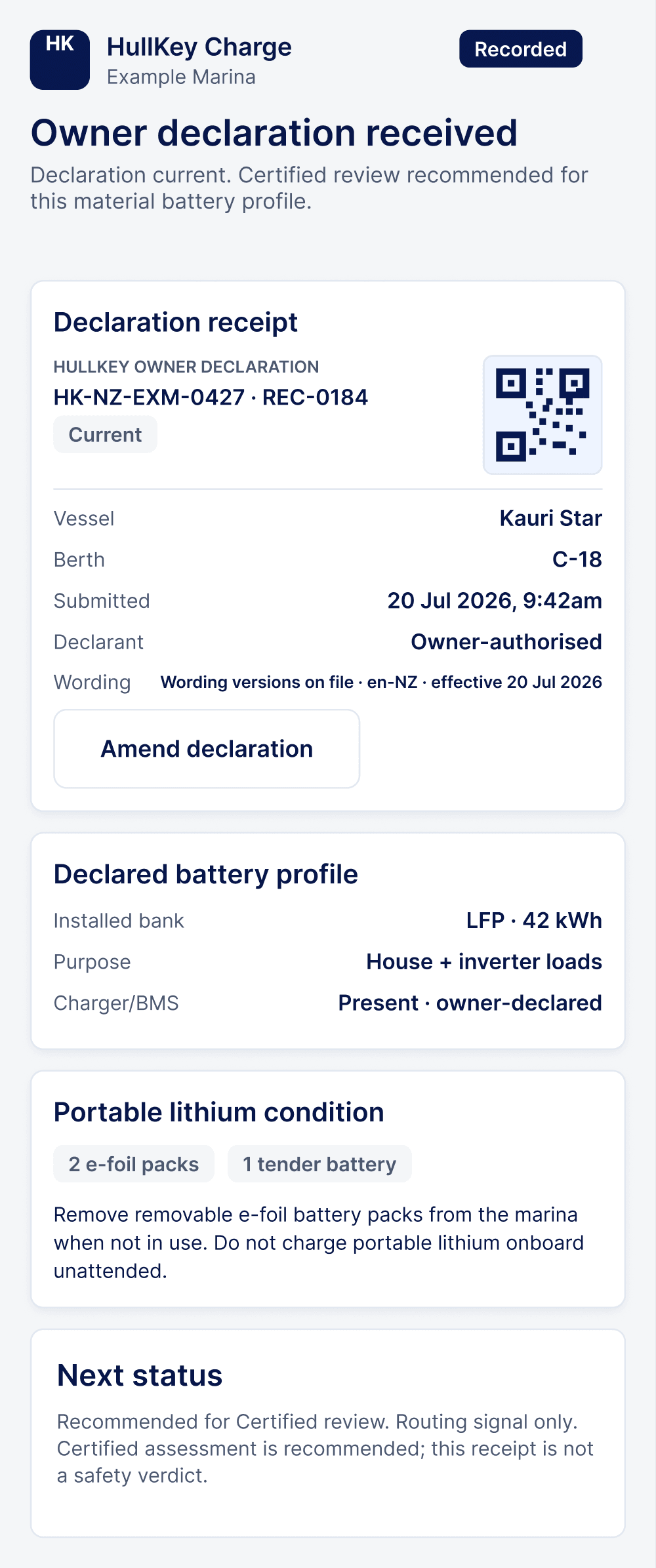
Fast charging, booked ahead.
A fast charger is a scarce resource, like a travel lift. To roster it you need to know which visitors are arriving and how long each will take to charge.
HullKey Charge keeps the battery record with the boat, not with one marina. An owner shares it ahead of arrival. Your team offers a charging slot, says how much energy it can supply for that window, and confirms it meets the owner's plan.
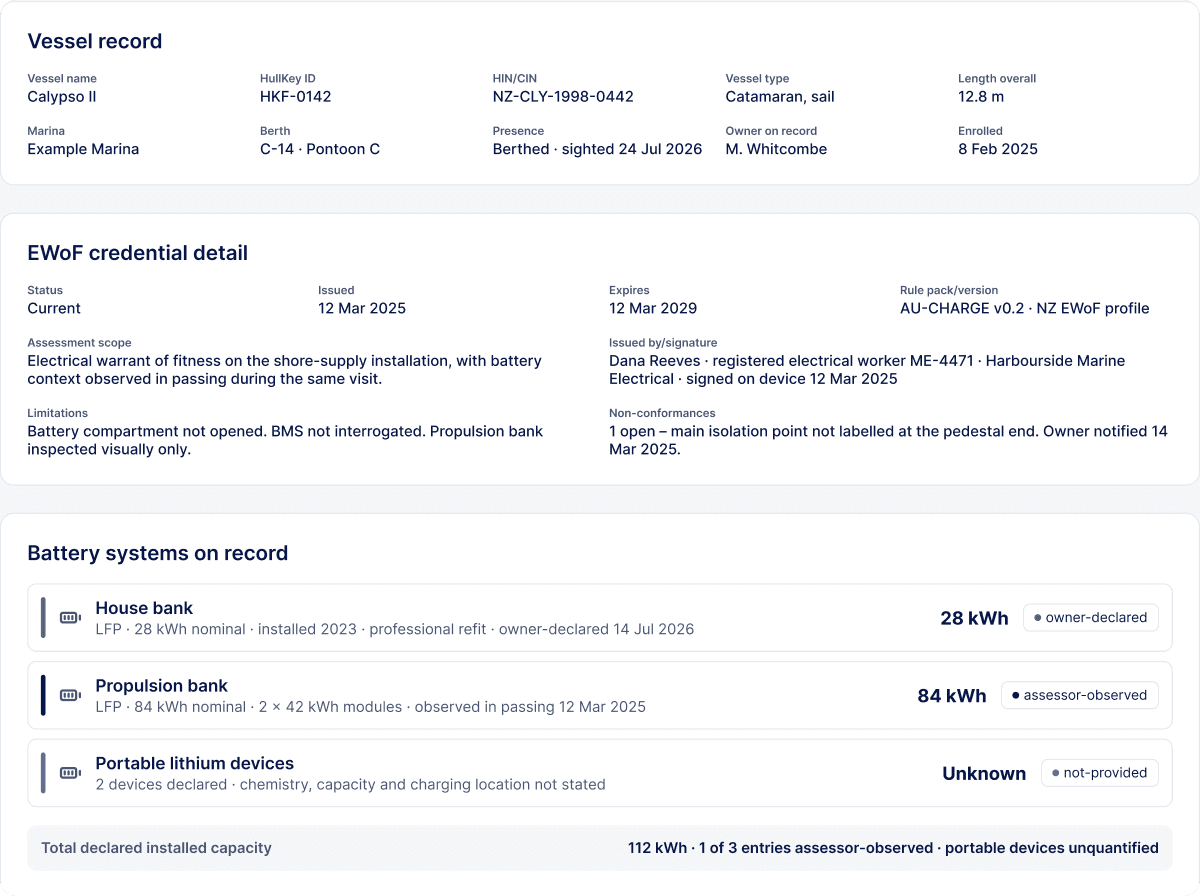
Know how much power your pontoons will need.
A charger company will tell you demand is rising. It can't tell you which boats on your pontoons carry the big banks, which fingers they cluster on, or how fast the total grows each year. Those numbers size a grid connection and decide where the first chargers go. Plan early; grid upgrades can take years.
They also let a board read a charge-point operator's offer against its own data, and decide who sells the kilowatt-hours to the boat owner: you, or the company that owns the charger.
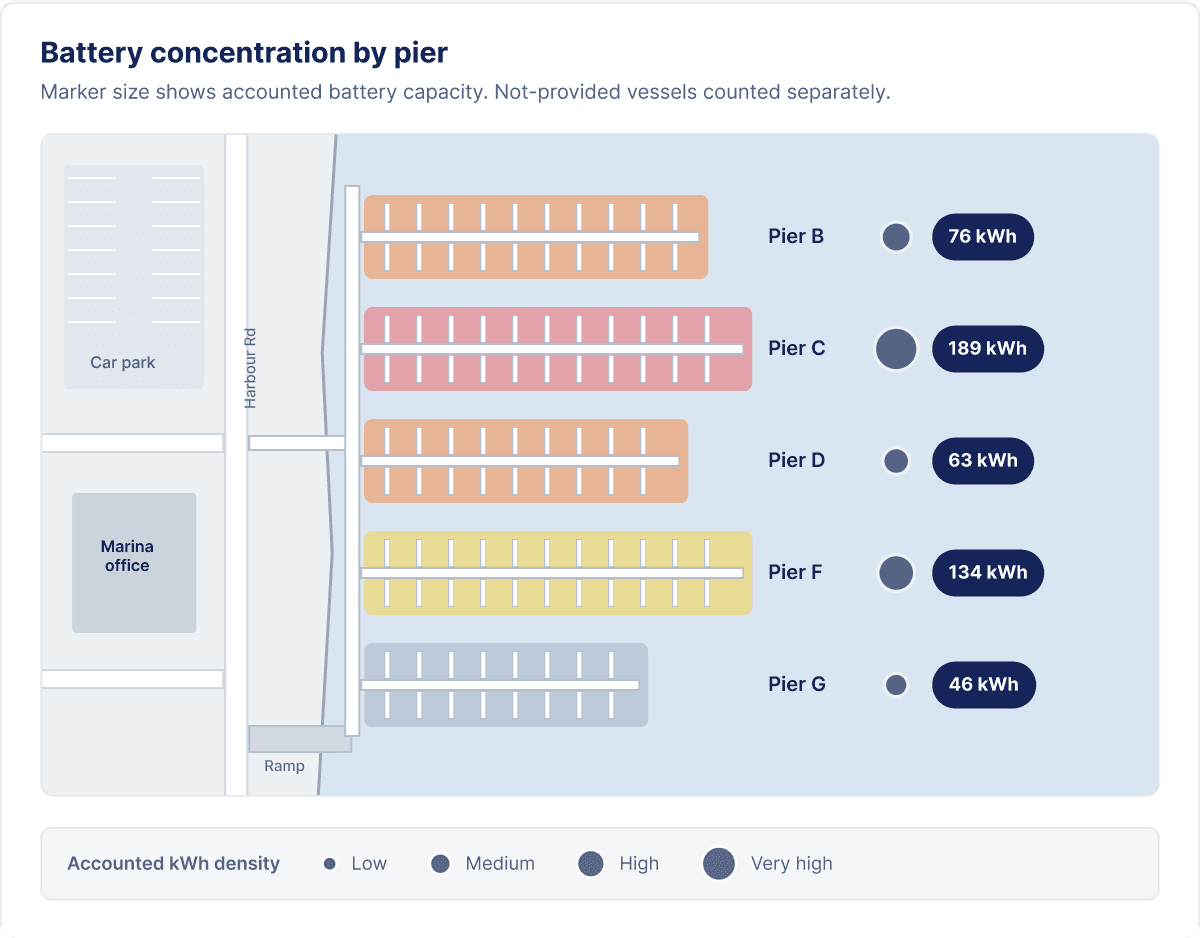
Every declaration is a lead.
Boats electrify in steps: an electric outboard on the tender, a lead-acid bank swapped for lithium, a 12 volt system rebuilt at 48 volt. Each step needs a marine electrician, parts and a place to do the work.
The marina that holds the record knows which owners are due for which step, and gets the call first.
- An electric outboard on the tender
- A lead-acid bank swapped for lithium
- A 12 volt system rebuilt at 48 volt
Questions marinas ask
Why isn't this a field in your marina software?
Because it's evidence, not admin.
The owner signs a dated declaration against published wording, and HullKey holds it outside your own systems, with the version the owner signed on file. If an insurer, the safety regulator or a coroner ever asks, the answer is on record. That record is your directors' evidence of due diligence.
Because the boat moves.
There is no universal marina software, and a visiting boat's declaration is no use locked inside another marina's system. The record travels with the hull.
Because it's the same form everywhere.
One published declaration, the same questions at every marina, so the answers add up across a fleet and across a portfolio.
We can connect HullKey Charge to your marina management system, so each declaration shows against the boat's record. The signed original stays on file with HullKey.
Start with a declaration. Everything else builds on it.
Owners declare.
Each berth holder signs a short declaration: installed batteries, whether each is new or second-hand, portable lithium, chemistry, capacity, charger.
The marina sees the picture.
One page shows the board what's declared, what's still unknown and where the energy sits on the pontoons.
Follow-up where it matters.
The few boats that hold most of the energy can be routed to a HullKey-approved assessor for a scoped check.
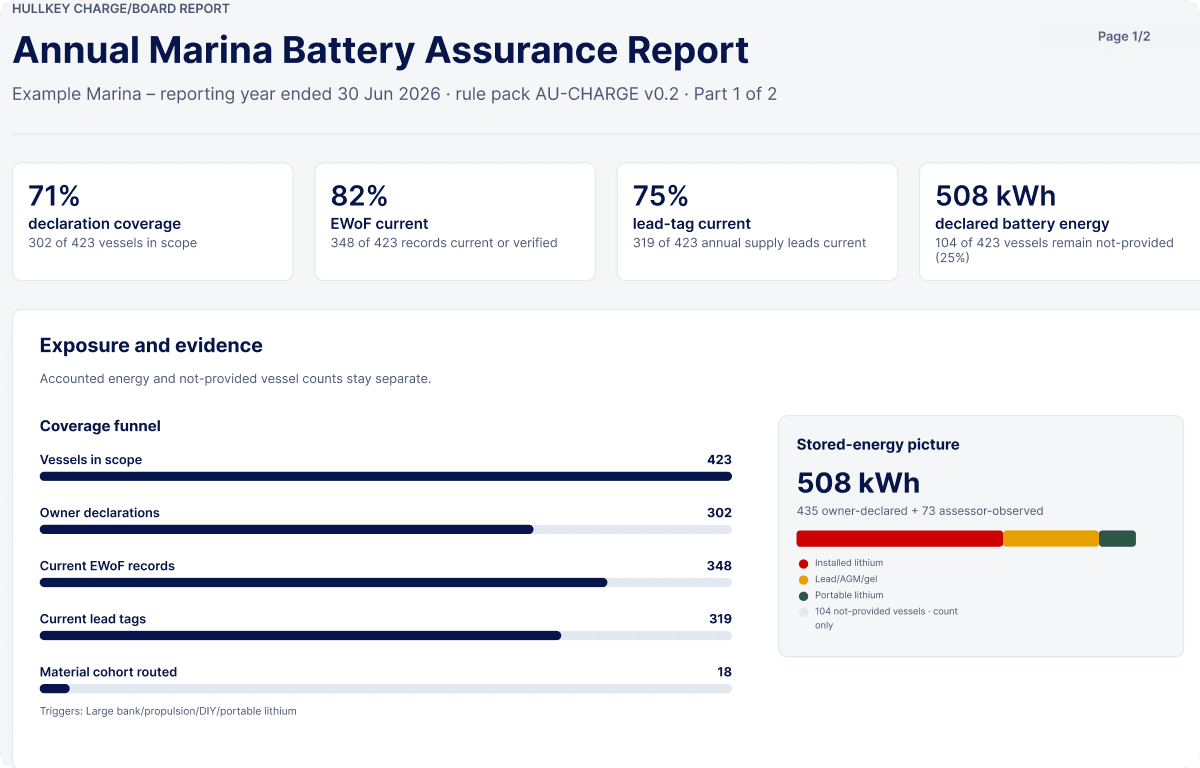
HullKey records evidence at a declared assurance level. It never declares a vessel safe.
Every warrant and tag in one record
New Zealand marinas already run one of the strictest shore-power regimes anywhere: an Electrical Warrant of Fitness (EWoF) every four years and an annual lead test-and-tag. HullKey Charge holds every warrant and tag in one digital record with its expiry date. Renewals become a list instead of a search through emailed photos, and the board sees compliance across the whole marina on one page.
The owner's battery declaration sits alongside it in the same record.
Evidence on file
Calypso II · Berth C-14 · Example Marina
Owner battery declaration
Submitted 14 Jul 2026 · signed by M. Whitcombe
owner-declaredCurrentEWoF certificate
Issued 12 Mar 2025 · current to 12 Mar 2029 · Dana Reeves ME-4471
assessor-observedCurrentAnnual supply-lead tag
Tagged 12 Mar 2025 · retest due 12 Mar 2026
assessor-observedExpiredBattery-system addendum
Not on file · vessel exceeds 100 kWh, due at next assessment
not providedMissing
Find out which boats on your pontoons carry lithium.
Leave your details and we'll show you what the first declaration round would give your board.